In modern times, there are many types of decks used for divination, or cartomancy (a form of divination using cards). Tarot is one of these. Tarot decks have proliferated across nearly every country & are printed in almost every language. They typically consist of 78 cards: 22 Major Arcana (usually numbered 0–21 in Roman numerals) & 56 Minor Arcana (typically Ace through Ten, plus Page, Knight, Queen, & King—the deck’s court cards).
In modern times, the Major Arcana are most often, from 0–21: The Fool, The Magician, The High Priestess, The Empress, The Emperor, The Hierophant, The Lovers, The Chariot, Strength, The Hermit, The Wheel (of Fortune), Justice, The Hanged Man, Death, Temperance, The Devil, The Tower, The Star, The Moon, The Sun, Judgment, & The World.
The four suits of the Minor Arcana represent the four physical elements: Wands (fire), Cups (water), Swords (air), & Pentacles (earth). The Major Arcana represents ether or spirit. Sometimes the elemental associations differ — for example, Wands may represent air & Swords, fire. The names of the suits can also vary from deck to deck; one of the most common changes is that Pentacles are often referred to as Coins or Discs. Some decks also use different court card titles—for instance, instead of Page, Knight, Queen, & King, they might have Princess, Prince, Queen, & King, or other titles altogether.
Origins of Tarot
Tarot originated as a card game, popularized by the Mamluks in Egypt before the 1300s.
These cards circulated throughout Europe, especially after paper spread from Asia. By the late 1300s, Europeans were producing their own decks, the earliest of which were based on the Mamluk cards. Tarot represents one of the earliest known card games.
Known as Tarot or Tarocchi, the game became popular in Italy before spreading throughout Western Europe. The card game itself declined by the 20th century. It’s uncertain when tarot decks were first used for divination, but evidence shows it was before the mid-1700s.
The Golden Dawn & the Birth of Modern Tarot
In the early 20th century, the Hermetic Order of the Golden Dawn — a secret society devoted to occultism, Hermeticism, and metaphysics — made significant changes to tarot theory and practice. These changes later influenced Wicca, Thelema, and other modern magical traditions.
The Golden Dawn believed tarot had esoteric links to Kabbalah (Jewish and Christian mysticism), Tantra (the Indian practice of esoteric yoga), the I Ching (Book of Changes, a Chinese divination method), and the Books of Thoth (Egyptian magical texts attributed to the god Thoth, associated with writing and knowledge).
While other Golden Dawn members created decks—such as Aleister Crowley’s Thoth deck—Arthur Edward Waite and Pamela Colman Smith created the most famous: the Rider–Waite–Smith deck (named for its publisher, creator, and artist, respectively). This deck is considered the first genuinely modern tarot deck, drastically expanding tarot’s symbolism and accessibility. It became the template for countless later decks.
Tarot Today
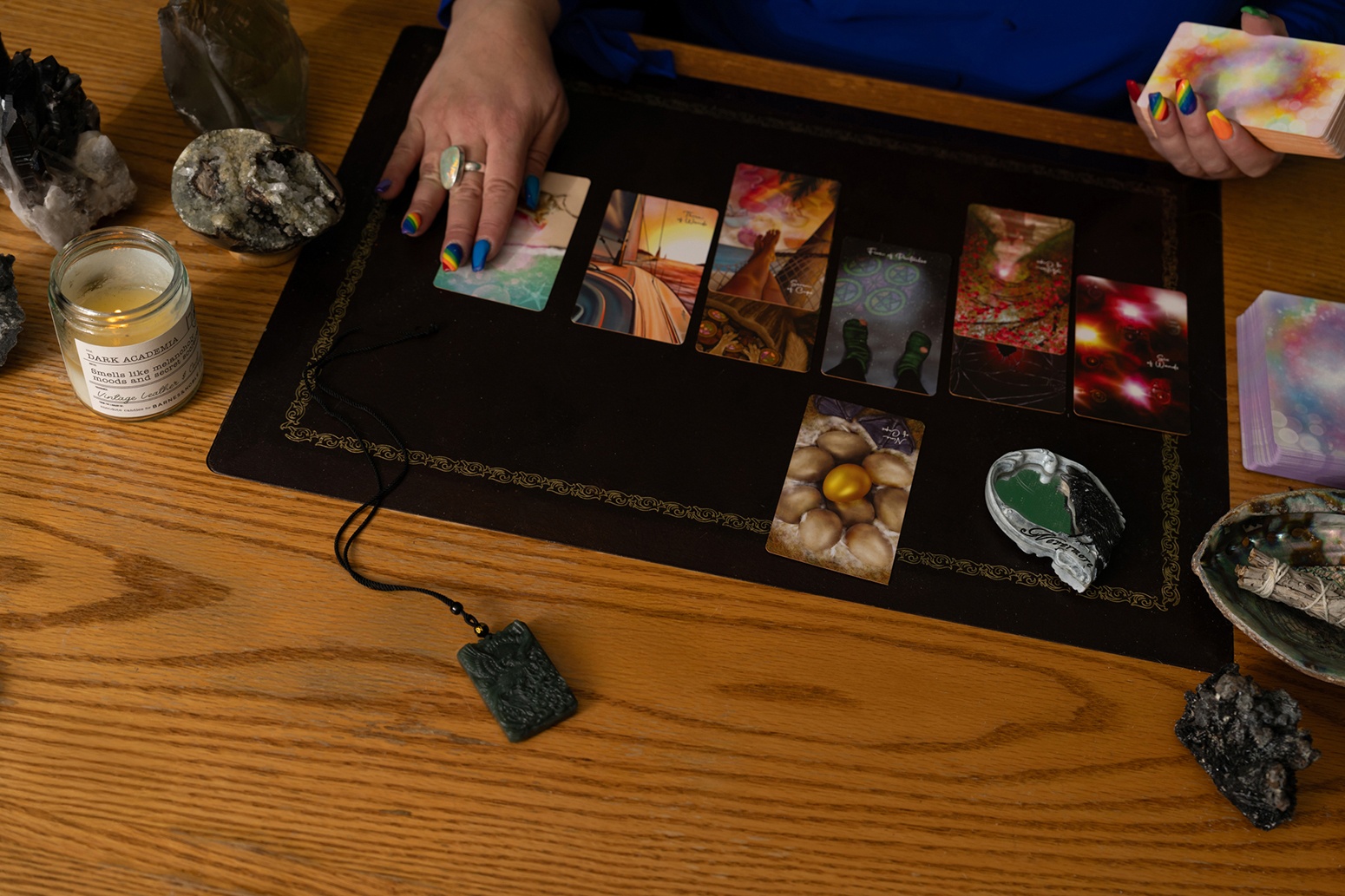
Now, a tarot deck can feature any subject or art style. Decks may be themed—or not—and their imagery can include drawings, paintings, collages, sculptures, AI-created imagery, or anything else a creator imagines.
Tarot’s imagery is central to intuitive reading. Symbols are the foundation of interpretation. A symbol is “a thing that represents or stands for something else,” according to the Oxford Languages Online Dictionary—like the hammer and sickle representing the Soviet Union, or the crescent moon and star representing Islam. Many things can serve as symbols: colors, numbers, shapes, and more.
Interpreting Tarot
There are three primary methods of interpreting tarot imagery:
- Through the Collective Unconscious.
These symbols are part of what Carl Jung referred to as the Collective Unconscious—a shared, inherited layer of the human mind that contains universal archetypes. This aspect of the unconscious isn’t based on personal experience but on the accumulated experiences of our ancestors. The Collective Unconscious manifests in myths, art, dreams, and religions, revealing universal patterns that link all human cultures. - Through personal experience and learned correspondences.
Readers may draw on systems like numerology (the occult study of numbers), elemental correspondences (links between suits and elements), semiotics (the study of signs and symbols in context), and astrology. Personal intuition—both from the reader and the querent (the person receiving the reading)—also plays an important role. - Mixing the first two methods.
Spreads & Reading Styles
Tarot readings are usually done with spreads—specific ways of arranging cards on a surface, where each position has a particular meaning. Some readers use traditional spreads, while others design their own for each session.
When a reader creates a custom spread, the querent receives a highly tailored reading based on their specific questions. Some readers ask for one central question, while others use a main theme and one sub-question per card position.
Personally, I create new spreads for every reading to provide my clients with individualized, focused insights. However, other methods can also work beautifully.
The Purpose of Tarot
Today, tarot is used primarily for divination and reflection. It can explore the future, uncover hidden feelings, or deepen self-awareness. To me, its most significant value lies in helping us connect with the Divine, understand our emotions, and find clarity.
Tarot’s potential is nearly limitless. You’ll learn more about how it works in the next post.


